Ross Reviews: Spano Conducts Bernstein + Rachmaninoff
Concert Reflections with Jon Ross
In this series from local music journalist Jon Ross, he reflects on the ASO’s Delta Classics Series with fresh insights into each concert.
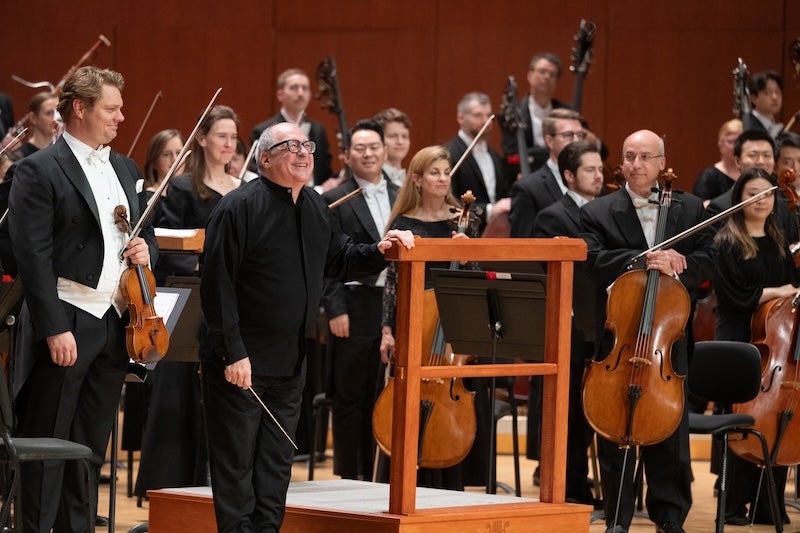
Music is connection, relaying emotion from performer to listener when simple words can’t suffice. But there’s also the connection among performers, the flow-state bond created when making music at a high level. When on-stage collaborators are working hand in hand, that close-knit feeling naturally transmits to the audience. Listeners, in turn, radiate appreciation and positivity back to the performers on stage.
It’s a closed loop of good vibes.
On Thursday, for the first of his two concert series back at Symphony Hall this season, Music Director Laureate Robert Spano brought along two familiar faces: mezzo-soprano Kelley O’Connor and pianist Sir Stephen Hough. Spano has worked with O’Connor, both in Atlanta and elsewhere, so frequently that the two have created a deep musical friendship that’s impossible to ignore. Hough and Spano are also frequent collaborators, last performing together at the 2025-2026 season opener at the Fort Worth Symphony Orchestra, where the conductor serves as music director. (Hough was last in Atlanta with Spano in 2022 for Saint-Saëns’ Piano Concerto No. 4.)
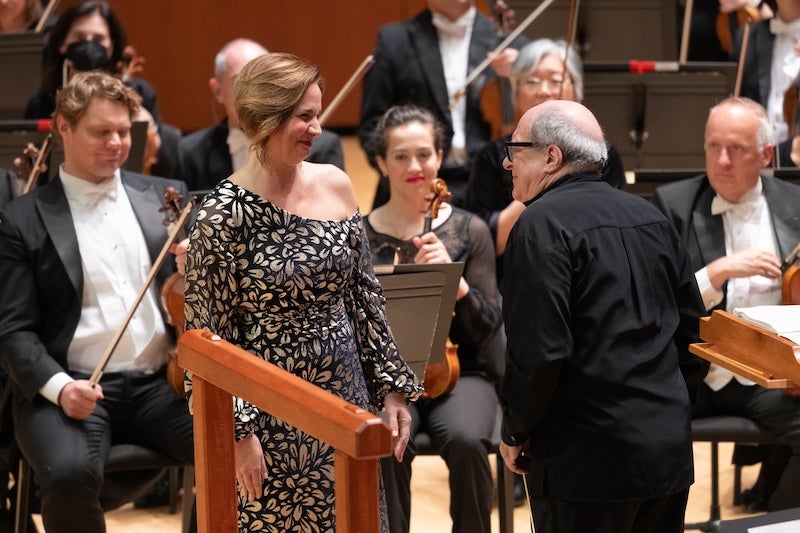
The programming on Thursday also felt familiar. Spano and the orchestra began with the Atlanta premiere of “On the Bridge of the Eternal” by Christopher Theofanidis, a celebrated member of the Atlanta School of Composers. O’Connor joined for the brilliant First Symphony by Leonard Bernstein, a composer performed often this year during America @ 250 festivities, and Hough took the stage to perform Rachmaninoff’s Third Piano Concerto, last heard at Symphony Hall in 2024.
Spano began the concert with “Eternal,” which can be seen as an expansion of an a cappella movement in Theofanidis’ “Creation/Creator,” premiered by the ASO in 2015. Both draw inspiration from St. Augustine’s “The Confessions,” which the composer said is a “rumination on the nature and mystery of time.” Indeed, the work opens with an almost supernatural string sound, feeling both introspective and searching but also pleading. After a slow build, heraldic horns, with an edge of discord, enter. The piece has bits of thunderous epic majesty, a sweeping cinematic quality, mixed with music that feels deeply personal, almost as if it’s meant for the musician alone. Overall, the composition seems celebratory, but there’s a deep mysticism that leaves this interpretation wanting. At the heart of the work is questioning, grappling with divergent ideas. It’s a thrilling work from a composer with deep ties to the orchestra.
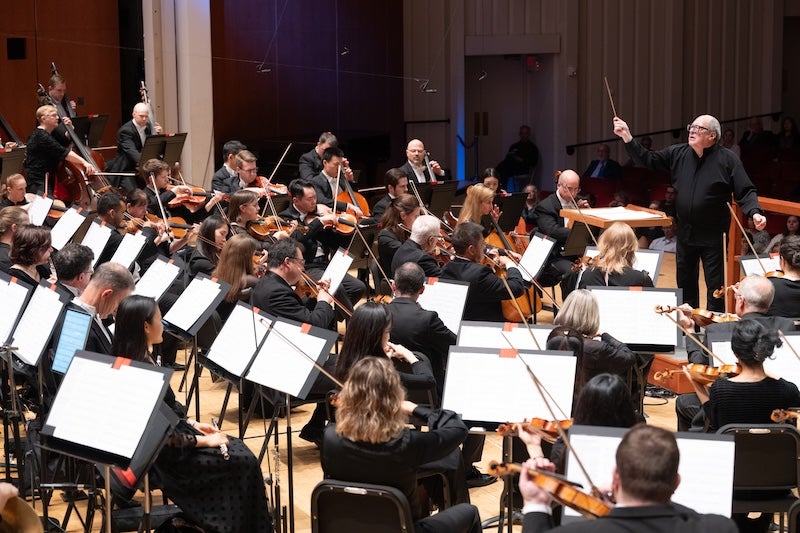
Bernstein’s First Symphony picked up that thread of string-led mystery, at least initially, quickly showcasing the ASO’s robust horn section. The programmatic “Jeremiah” is full of mourning and sorrow, the gripping music transmitting emotions that words could not express. O’Connor appeared in the final part of the three-movement work, singing a lament that, at least for me, and excuse the trite expression, truly stopped time. I immediately wanted to hear an encore of the entire work.
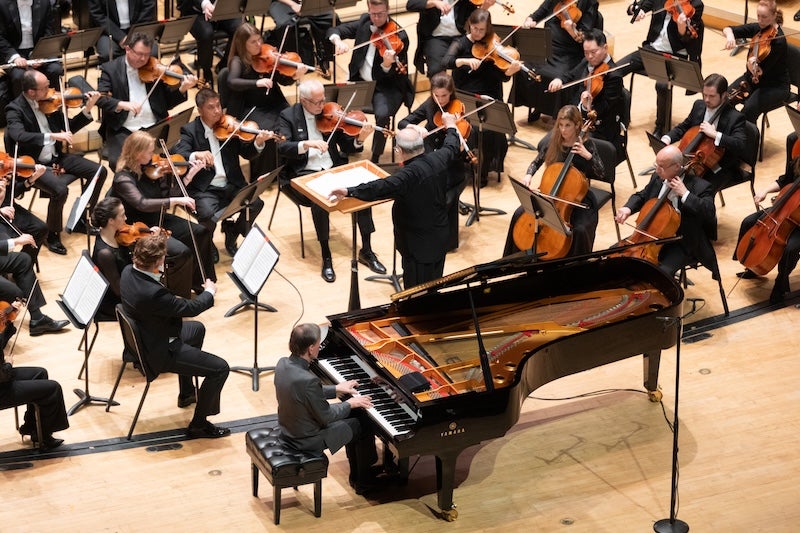
Weaving through a repeat performance of an American symphony masterpiece would have cheated the audience of dazzling piano mastery. After intermission, Hough encapsulated extremes of emotion in his fingers. There he was, forcefully flying up and down the keyboard in a dizzying counterpoint before turning to light, twinkling arpeggiations to accompany a serene woodwind melody. In the next moment, his bravura technique was on full display during cadences packed with vertiginous technique. In the work, any placid playing always seems relatively short-lived, and Hough vigorously and athletically ran through this thunderous showpiece. With attentive conducting by Spano, Hough presented a work both thrilling to watch and hear.
Thursday’s marvelous program repeats May 2 at 8 p.m. before Spano and the ASO take to the road for a 3 p.m. performance on May 3 at the University of Georgia’s Hodgson Concerto Hall. Spano returns for Mother’s Day Weekend, May 7 and 9, pairing Bernstein’s second symphony with “Harold in Italy” by Hector Berlioz.