Eternity, Humanity and the Throughlines of America @ 250
An interview with Music Director Laureate Robert Spano and Lois Reitzes
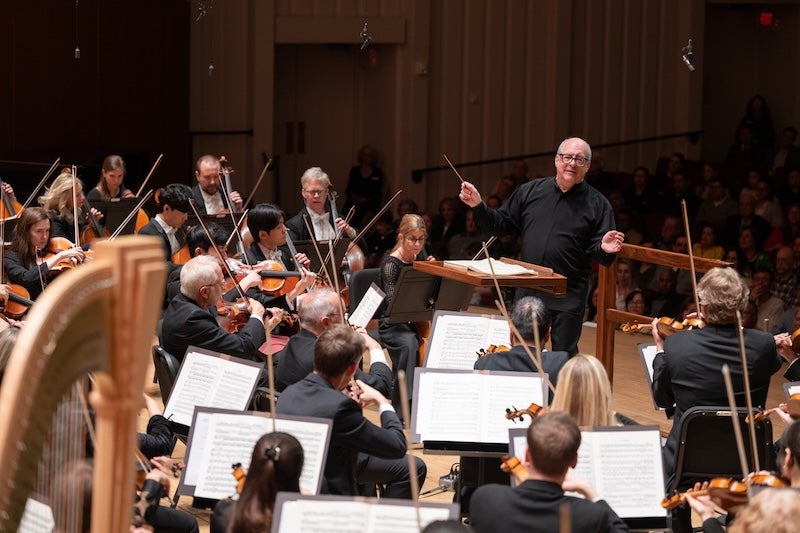
Robert Spano leads two weeks of ASO concerts, contributing a throughline of storytelling to the America @ 250 series. In a recent interview with Lois Reitzes, Spano reflects on the themes of the featured repertoire and his collaboration with many of the highlighted musicians.
This interview has been edited for length and clarity.
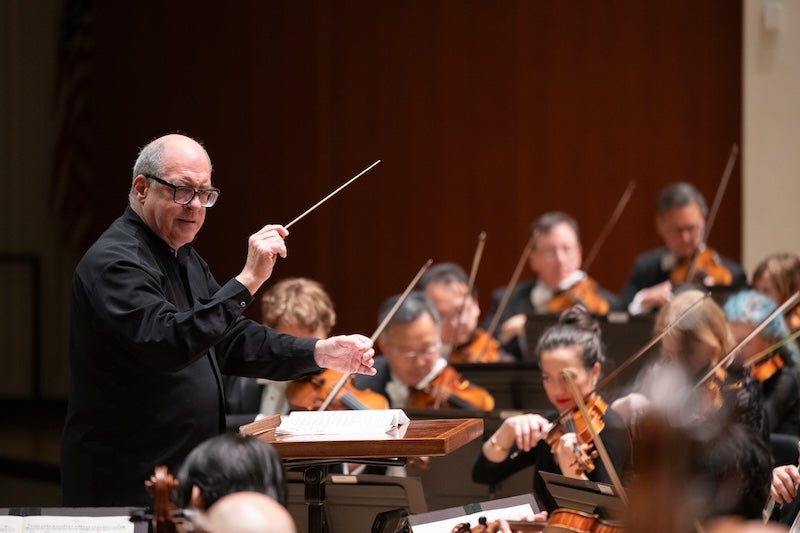
Lois Reitzes: American music has a long-time champion in conductor Robert Spano. During his 20-year tenure as Music Director of the Atlanta Symphony Orchestra, Maestro Spano commissioned 28 works and co-commissioned another 13 works as part of his initiative to advocate for living American composers. So, it's perfectly fitting that as the ASO Music Director Laureate, he returns to conduct two weekends of concerts that are part of the orchestra's America @ 250 celebration.
Many living American composers whose works you've championed were presented with your special designation as the Atlanta School of Composers, including Christopher Theofanidis. His music opens the first concert, and he said it was inspired by a text from St. Augustine. Please tell us more about On the Bridge of the Eternal.
Robert Spano: I'm very excited. For any of our audience who remembers Chris’ Creation/Creator that we did some years ago, there was a movement that used this text of St. Augustine, regarding eternity. And it is a stark text. And he set the most beautiful a cappella movement to it in Creation/Creator. And then a few years ago, he was commissioned to write this, so it's an extrapolation or a kind of fantasy inspired by the a cappella movement, but it's strictly for orchestra.
LR: Chris wrote in his program notes that he was inspired by a text from St. Augustine, and he described it as “a rumination on the nature and mystery of time.” And it seemed to me, that there was something both religious but at the same time more modern in its sentiment. It had almost a physicist's take on time embedded in it. Robert, that struck me as something of a throughline for your own worldview.
RS: Well, Chris articulated it so much better than I tried to. It became, for me, the kind of kernel of the whole work of Creation/Creator, because that was the beauty of the larger work in my mind–this combination of texts from mystics, from religious thinkers, from scientists, from artists–not taking just one point of view, but all these different possibilities. I thought it was one of the most beautiful things about the tapestry of that work.
LR: You chose two symphonies by Leonard Bernstein for both series of ASO concerts, beginning with his Symphony No. 1, “Jeremiah.” Over three and a half days, over 30 years after its 1944 premiere, the composer said, “The work I have been writing all my life is about the struggle that is born of the crisis of our century, a crisis of faith.” Though specific to the Book of Lamentations from the Hebrew Bible, how does Bernstein's “Jeremiah” Symphony connect or juxtapose with Theofanidis’ On the Bridge of the Eternal?
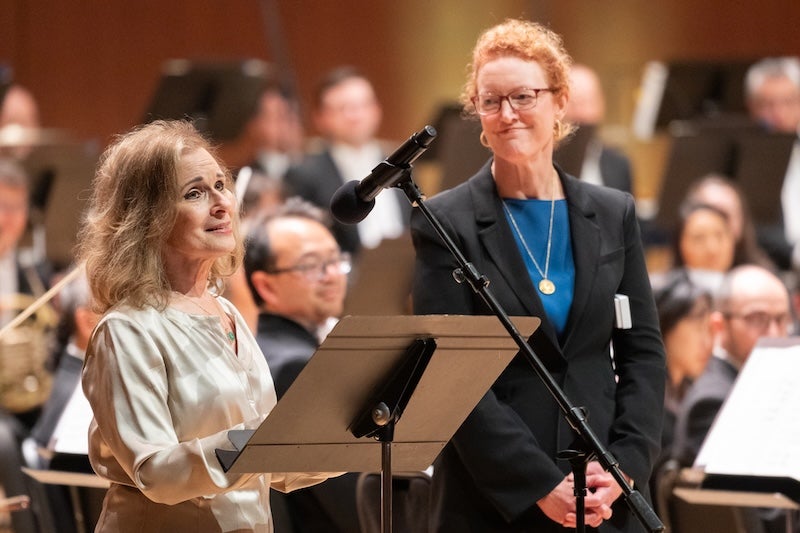
Lois Reitzes receiving the Golden Ticket from the ASO in Spring 2025.
RS: Well, I love that you brought that up. Bernstein's declaration, because all three of the symphonies, specifically the symphonies, address this head-on. Jeremiah with the plight of human suffering. How does one reconcile that with the divine, [Symphony No. 2] “The Age of Anxiety”? And then the Third Symphony, again, grappling with issues of death, suffering, life, and crisis of faith. It's so intrinsic to his work and to his character and his music. It's beautiful that he said it so explicitly.
And then to put it next to the Theofanidis, I was interested to take this work inspired by Augustine, pointing to the possibility of an eternal world which is outside of time. In some way, what Chris was pointing to with the almost clinical nature of the text as well as its power. Maybe in its own way, is speaking to the same problem Mr. Bernstein is with the lamentations of “Jeremiah” in the First Symphony.
LR: Another collaborator on this first concert is the pianist Sir Stephen Hough. He’s performed as a soloist with you several times. What is it like working with him?
RS: It's so easy and fun. We have a very good time. He's such a tremendous musician, you know, and he brings such insight into everything he plays. I'm especially excited because he and I have never done Rachmaninoff Three together. It's an amazing couple of weeks with these two pianist composers [Hough and Tao], two different generations–it's very exciting to have them back-to-back like that.
And not to be forgotten is Zhenwei Shi, our Principal Viola, in Harold in Italy, which was commissioned from Berlioz by Paganini. It's a showpiece to show off a great violist and I'm so happy that Zhenwei is going to be doing it. He's just one of the most phenomenal violists I've ever heard anywhere. So, it's just exhilarating to put him in the spotlight.
LR: Leonard Bernstein regarded W.H. Auden's book-length poem, The Age of Anxiety, as “one of the most shattering examples of pure virtuosity in the history of English poetry,” to quote the composer, naming the cultural condition of the mid-20th century. How does this piece for piano and orchestra reflect the problematic search for faith that Bernstein wrote about all his life?
RS: I've long studied that poem in relation to the piece, even searching for the direct correspondences of which passages in the poem correspond to passages in the music. And I've not found that as fruitful. But what I found more powerful is capturing the mood rather than the narrative. I don't think it's necessary to know the poem to appreciate the music. I think the music, in its own right, captures certain affect, certain moods and emotional states that the poem similarly does.
LR: Tell us about the role of the pianist and why it's essential here.
RS: In a sense, that's the only reason I could think of to pair Harold in Italy with "The Age of Anxiety". Both are symphonies that feature a soloist, but yet they are not quite concertos. They are operating, and at times, the piano is extremely important as the main voice or even as the protagonist. And at other times, the piano is subsumed into being part of the orchestra and then emerging again.
LR: It's a fascinating relationship and these concerts are so rich. We cannot wait to hear them, Robert. And I must say, whenever you are on the podium in Symphony Hall, to all of us in the audience and listening, it feels like home.
The original interview with Lois Reitzes will air on WABE