Atlanta Symphony Musicians Prepare for Brahms Revealed Festival
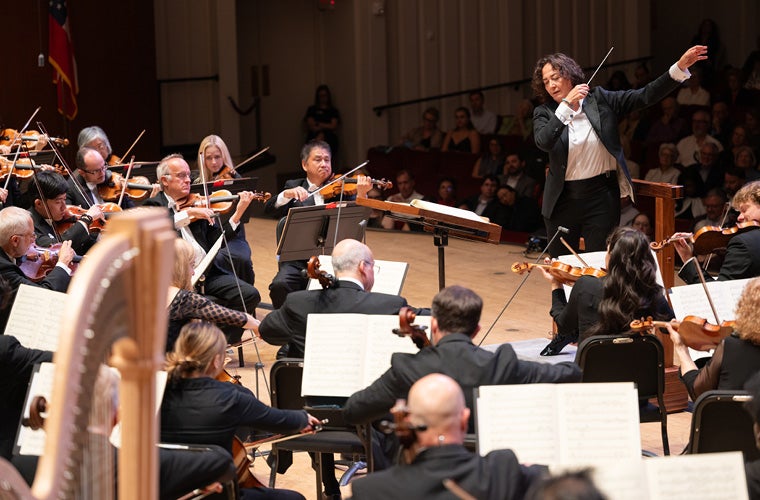
When Gloria Allgood first performed the Brahms Violin Concerto, tears welled in her eyes. The bassist, who has been part of the Atlanta Symphony Orchestra (ASO) since 1984, got a chance to play the piece as a teenager during a summer trip to Interlochen Center for the Arts, but the music had been imprinted on her mind long before.
“My history with Brahms goes back to when I was a tiny child. The piece that was always floating around on the record player was the Brahms Violin Concerto,” she said. “I love that piece, and I’m so thrilled we’re playing it.”
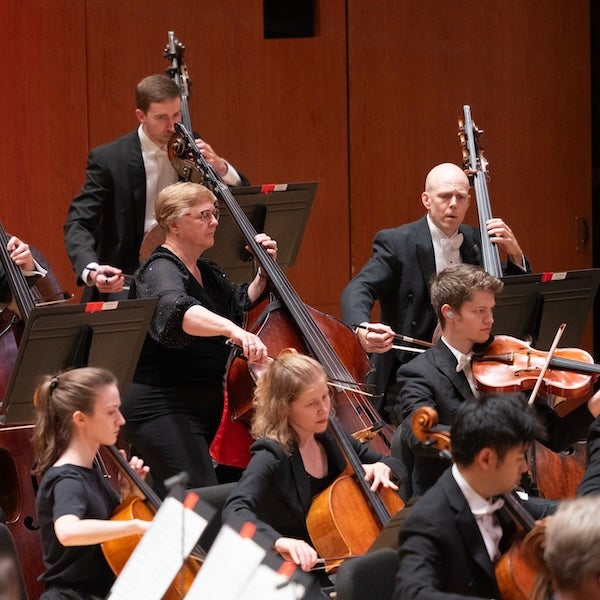
Allgood’s deep familiarity with Brahms is not unique among musicians. Many of her on-stage colleagues first played the composer’s music long ago: Sections of his works make up well-worn audition pieces, and the symphonies are a hallmark of university orchestra programs.
With Brahms Revealed, a season-long study of Brahms spanning the composer’s four symphonies and six additional seminal works (Violin Concerto included), Music Director Nathalie Stutzmann will tap into that familiarity while creating her own artistic vision of the composer’s music.
During Stutzmann’s first performance of the season (OCT 1-4), the ASO pairs Brahms’ First Symphony with the concerto, welcoming Johan Dalene as the soloist. The very next weekend, it’s on to the Third Symphony, juxtaposing the work with bits of Wagner operas. Stutzmann leads five additional concert series showcasing Brahms' works. On April 15, Music Director Laureate Robert Spano returns to Atlanta to conduct, among other works, Brahms’ Fourth Piano Concerto with soloist Dejan Lazič.
Stutzmann is bringing her Brahms interpretations on the road as well. She’s scheduled to perform the First Symphony with orchestras in Zürich and Monte Carlo toward the end of the year.
Allgood contrasts this season’s Brahms Revealed series, which she likens to walking through a museum of his music – an immersive experience that lets both the audience and the musicians really dig into the composer’s point of view – with the ASO’s recent in-depth examination of Beethoven. The music this time around, she said, will be more broad-natured, less articulated and perhaps more rhythmically challenging than those Beethoven works from two seasons ago.
“There’s a weight to Brahms that is a little different than Beethoven,” she said, explaining that Brahms is more about emotion and passion. “But in the same breath, he was intimidated by Beethoven so badly that he didn't even start composing symphonies until he was 40.”
The composer’s long lines have a song-like quality that is perfect for something that has become a hallmark of Stutzmann’s tenure in Atlanta: singing instrumental phrases to the orchestra during rehearsal to demonstrate the song-like quality she searches for in instrumental phrases.
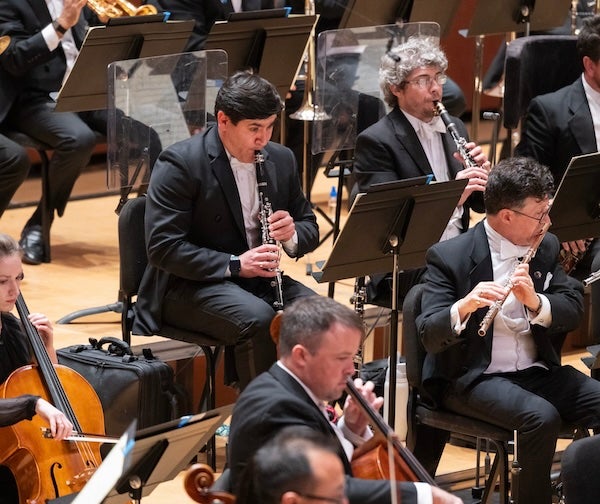
“We always talk about, in Brahms, playing the most expressive way, kind of imitating the human voice,” said clarinetist Iván Valbuena. He noted that sometimes these passages are deceptively simple at first glance, leading to oceans of depth and nuance on repeated study. “He’s always making everything a little bit more challenging to understand. And definitely you can see that evolution from one symphony to another.”
It’s a musical outlook that highlights emotion, Allgood said, and the concentration of Brahms' works will really allow the orchestra to bask in that worldview.
“You really get into the style,” she said of the intense focus. “It's like learning a foreign language – you almost start thinking in that language.”
As a clarinetist, Valbuena holds late Brahms close to his heart, calling him one of the most important composers for the instrument. Those important works all came near the end of his life, years after he finished his final symphony: Brahms wrote a clarinet trio and a quintet in 1891, then a pair of clarinet sonatas, written three years before his death in 1897.
But even in the Brahms Revealed works, Valbuena points to radiant clarinet passages. The third and fourth symphonies have solos that “you practice all your life,” he said, his voice animated at the thought of applying all that academic study into performance with the ASO. These aren’t flashy bits of musicality, but they can be just as rewarding for musicians and audience members alike.
“It’s not super virtuosic in terms of playing really fast passages or making the solos look very impressive for the audience,” he said. “It’s a different approach. His music is so deep and so simple at the same time.”