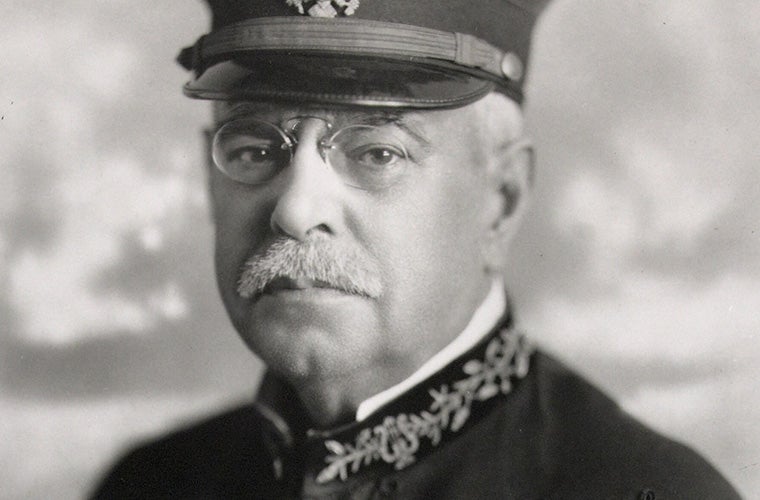
John Philip Sousa
1854 - 1932
Biography
John Philip Sousa was a legendary American composer, conductor, and innovator of the late Romantic era, widely celebrated as "The March King." Born on November 6, 1854, in Washington, D.C., to a Portuguese-Spanish father and a Hessian mother, Sousa grew up surrounded by military music. His father was a trombonist in the United States Marine Band, which deeply influenced young John’s upbringing. At just 13 years old, after attempting to run away to join a circus band, his father stepped in and enlisted him as an apprentice in the Marine Band. This pivotal moment launched a lifelong dedication to wind band music and shaped the future of American patriotic identity.
After leaving the Marines in 1875, Sousa spent several years traveling as a violinist, conductor, and composer for theater productions. His exceptional talent did not go unnoticed, and in 1880, he returned to Washington to become the 17th director of the U.S. Marine Band, known as "The President's Own." Over the next 12 years, Sousa revolutionized the ensemble. He instituted strict rehearsal standards, updated the repertoire with classical transcriptions, and transformed the group into a world-class premier musical organization. Under his leadership, the band served five U.S. presidents and began making some of the earliest commercial phonograph recordings in history.
In 1892, Sousa chose to leave military service to form his own civilian touring organization, simply called the Sousa Band. This elite group of musicians toured extensively for nearly four decades, performing thousands of concerts across the United States, Europe, and eventually embarking on a highly successful world tour. Sousa’s concerts were legendary for their precise execution, high energy, and crowd-pleasing variety. His popularity was so immense that he became one of America's first true musical superstars, proving that high-quality wind music could be commercially viable and globally influential.
As a composer, Sousa was immensely prolific, writing 136 military marches, 15 operettas, and numerous other musical suites. His unique genius lay in his ability to infuse traditional military structures with unforgettable melodic hooks and syncopated energy. Masterpieces like "Semper Fidelis" became the official march of the U.S. Marine Corps, while "The Washington Post" sparked a massive international dance craze. His absolute masterpiece, "The Stars and Stripes Forever," composed in 1896, captured the spirit of a burgeoning American century and was later designated by Congress as the official national march of the United States.
Beyond composition, Sousa left a lasting physical legacy on music by helping design the sousaphone. Created in collaboration with instrument manufacturers in the 1890s, the sousaphone is a modified tuba wrapped around the player's body with a forward-facing bell, specifically engineered to project deep brass tones over a marching band. Sousa continued to conduct and champion music education until his death on March 6, 1932, in Reading, Pennsylvania. Today, his timeless compositions remain a staple of American cultural heritage, echoing across modern football fields, parades, and concert stages worldwide.
Featured Events
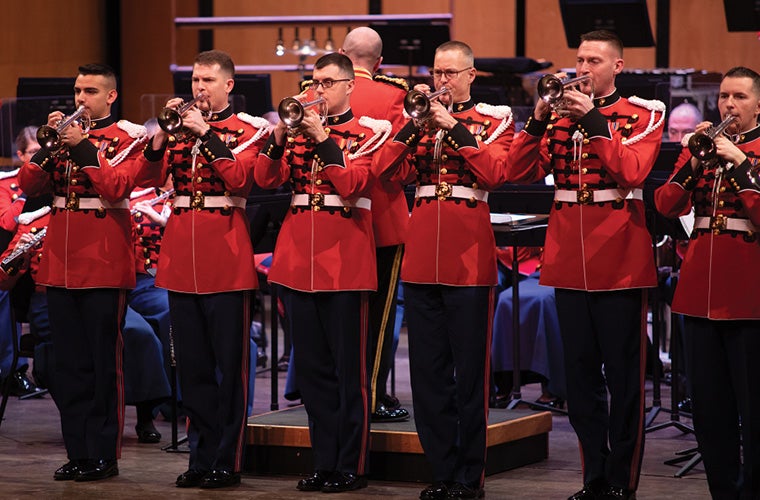
- A Salute to the Armed Forces of the United States of AmericaKnox
- March, "The Stars and Stripes Forever" (edited by The United States Marine Band)Sousa
- "The Crystal Lute" from The American Maid (lyrics by Leonard Liebling)Sousa
- Suite from Band of Brothers (arr. by LtCol Ryan Nowlin)Kamen
- March from 1941 (arr. by Paul Lavender)John Williams
- Cuban Overture (transcribed by R. Mark Rogers)Gershwin
- Riffs (2009)Jeff Tyzik
- Colonial Song (edited by Timothy Topolowski and Larry Clark)Grainger
- Spirit of America (2026) Jim Stephenson
- March, "The Glory of the Yankee Navy" (edited by The United States Marine Band)Sousa