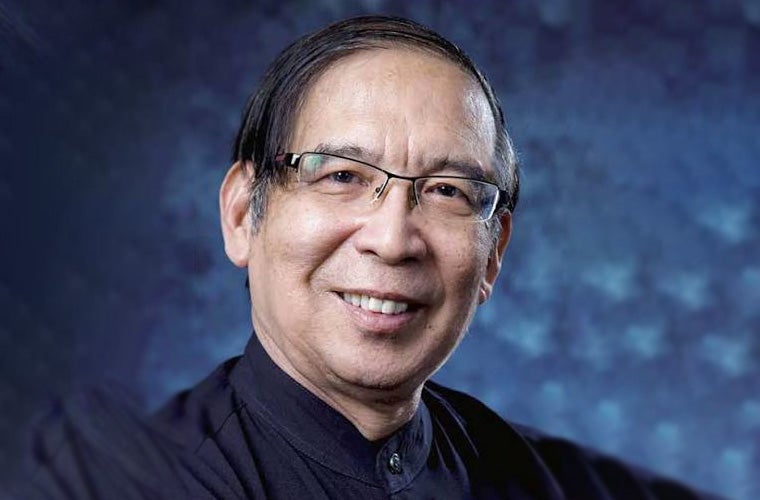
Bao Yuankai
b. 1944
Biography
Bao Yuankai is one of the most prominent and influential Chinese composers and music educators of the modern era, celebrated globally for his mastery in bridging Eastern cultural heritage with Western symphonic traditions. Born in Beijing on January 4, 1944, he began his rigorous musical journey at the affiliated middle school of the Central Conservatory of Music, initially studying the flute before shifting his focus to composition. He completed his formal education at the Central Conservatory in 1967, studying theory and composition under legendary Chinese pedagogues such as Su Xia, Jiang Dingxian, and Chen Peixun. This deep academic and classical foundation formed the bedrock of a career that would fundamentally shape the landscape of contemporary orchestral music.
As both a creator and a dedicated academic, Bao has spent decades expanding the reach of orchestral music education across Asia. In 1973, he joined the faculty at the Tianjin Conservatory of Music, later rising to become a professor and the head of its prestigious composition department. His influence as a mentor spans generations, having nurtured hundreds of young composers who have gone on to achieve international recognition of their own. Beyond mainland China, his artistic and pedagogical presence extended significantly into Taiwan, where he served as a professor at Nanhua University and dedicated a decade to exploring the island's unique cultural landscapes through symphonic writing. In recognition of his massive contributions to education and national culture, he was awarded the prestigious Chinese "Golden Bell" award for composition and received special lifelong funding from the Chinese State Council.
Bao’s compositional philosophy is defined by an extraordinary capacity to preserve the precise nuances, vocal inflections, and emotional depth of traditional folk tunes while deploying the immense dramatic power of a Western symphony orchestra. His monumental breakthrough came with the creation of Yan Huang Feng Qing) between 1990 and 1991. This masterpiece consists of six orchestral suites comprised of 24 pieces based strictly on regional Chinese folk melodies, ranging from the hauntingly delicate Hebei song "Little Cabbage" to vibrant regional dance rhythms. By wrapping these indigenous themes in sophisticated Western counterpoint and rich orchestral colors, Bao successfully brought the authentic sounds of the Chinese countryside into the standard global orchestral repertoire.
His creative output spans an impressive array of genres, including film scores, chamber music, choral masterpieces, and a powerful cycle of six symphonies—such as his Symphony No. 3 ("Peking Opera") and the grand oratorio Symphony No. 5 ("King Yu"). Another crowning jewel of his catalog is Sketches of Taiwan, a vivid symphonic suite born out of his deep love for Taiwan's landscapes and humanity, which has become one of the most frequently performed orchestral works representing Taiwanese culture. His monumental multi-movement cycle, Rhapsody of China, was performed in over 40 countries across nearly every continent within a single decade, proving the universal appeal of his musical voice.
Bao Yuankai’s music continues to resonate in major concert halls worldwide, recorded and distributed by premier international classical labels including Deutsche Grammophon, EMI, Philips, and Decca. His distinct ability to make traditional music speak a global language has earned him widespread acclaim across international media, featuring as a cover story for National Public Radio (NPR) in the United States, the People's Daily, and major European journals. Today, his works remain a staple for symphony orchestras looking to present programmatic music that combines dazzling instrumental virtuosity with a deep, cross-cultural soul.
Featured Events
- Spring Festival OvertureH. Li
- Colorful Clouds Chasing the Moon (arr. Y. Suzuki)Traditional
- "Largo al factotum della città" from Il Barbiere di Siviglia (The Barber of Seville)Rossini
- San-ah (Mountain)Dong-Soo Shin
- New WorkAlice Hong
- The Butterfly Lovers' Violin ConcertoZ. He & Chen
- Happy SunriseY. Bao