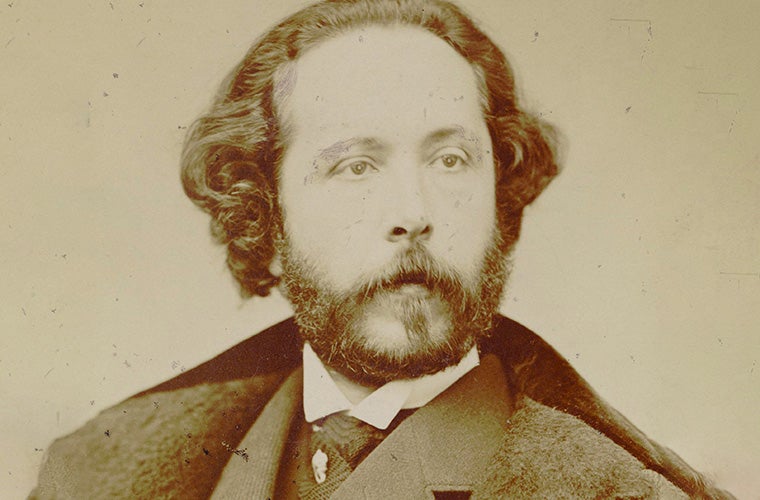
Édouard Lalo
1823 - 1892
Biography
Édouard Lalo was a defining voice in 19th-century French Romanticism, celebrated for his rhythmic vitality, brilliant orchestration, and a unique musical identity that bridged his French upbringing with his Spanish ancestral roots. At a time when the Parisian musical establishment was dominated by opera, Lalo became a pioneer for instrumental and chamber music, eventually gaining international fame for his innovative approach to the concerto and symphonic forms.
Born in Lille to a family of Spanish descent, Lalo’s early musical interests were initially met with stern opposition from his father, a Napoleonic military veteran. At age 16, he moved to Paris against his father's will to study violin at the Paris Conservatoire under François Antoine Habeneck. For decades, he supported himself as a teacher and performer, notably playing viola in the Armingaud Quartet—a group dedicated to promoting the "pure" chamber music of Beethoven, Mozart, and Schumann.
Lalo’s breakthrough did not arrive until his fifties, catalyzed by the founding of the Société Nationale de Musique in 1871. In 1874, he composed the Symphonie espagnole for the legendary virtuoso Pablo de Sarasate; this five-movement masterpiece redefined the violin concerto by blending Spanish folk rhythms with French orchestral clarity. He followed this success with his Cello Concerto in D minor (1877), which solidified his reputation as a master of the concertante genre. Though he struggled for years to find success in the theater, his Breton-inspired opera Le Roi d’Ys (1888) eventually became a triumph, and its overture remains a staple of the symphonic repertoire today.
His musical style is characterized by a "Germanic solidity" in structure paired with a characteristically French transparency in orchestration. Lalo’s influence extended to the next generation of composers, with Claude Debussy citing the ballet Namouna as a masterpiece of orchestral color. Today, Lalo is remembered as a fiercely independent artist who refused to belong to any single "system," leaving behind a legacy of works that are as rhythmically infectious as they are elegantly crafted.