Stutzmann Sets the Tone for Season-long Brahms Exploration
Concert Reflections with Jon Ross
In this series from local music journalist Jon Ross, he reflects on the ASO’s Delta Classics Series with fresh insights into each concert.
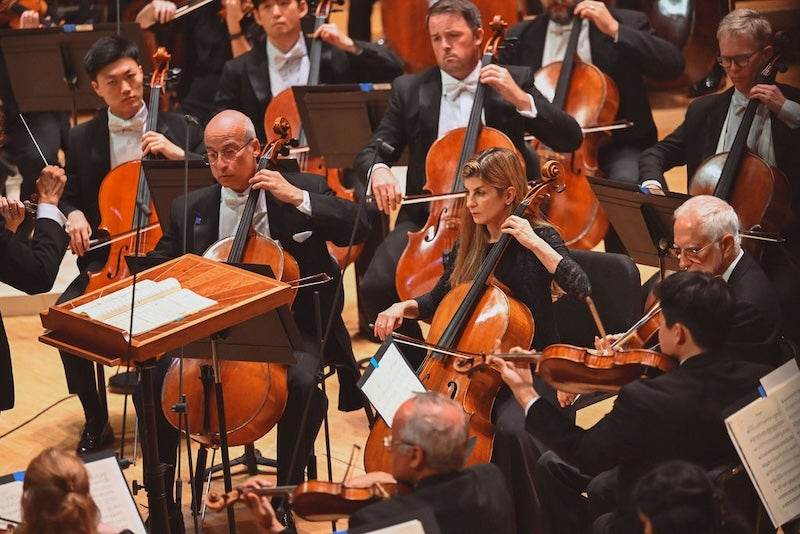
Handel’s “Music for the Royal Fireworks,” written in 1749, never goes out of style for a reason: There’s something refreshing, optimistic and joyful about the soaring trumpets, the robust string section supporting a courtly-dance melody in lockstep. It’s a refined, timeless sound.
On Thursday at Symphony Hall, Atlanta Symphony Orchestra Music Director Nathalie Stutzmann used the work’s “Overture” to herald the orchestra’s 82nd season. After the bite-sized Baroque welcome (which followed the requisite performance of “The Star Spangled Banner”), Stutzmann used Brahms’ Violin Concerto and his First Symphony to introduce emotions audiences will hear from the stage repeatedly this season: intense longing, frustration and nostalgia, perhaps mixed with a bit of anger. Encompassing eight concert series, the ASO’s year-long Brahms Revealed project encompasses the composer’s four symphonies along with concertos a plenty, the “Academic Festival Overture” and “Ein deutsches Requiem,” featuring the ASO Chorus.
The composer’s First Symphony, which opened the second half of Thursday’s concert, brought audiences right inside those Brahmsian passions during the first few bars of music. Baked by the relentless, measured pounding of the timpani – a thundering, inescapable, heartbeat – teeming strings wove a dense, rich fog of what sounded like heartbreak and regret. Instead of a musical bystander – looking on and watching a performance, as I did with the buttoned-up sounds of Handel – the ASO’s string section placed me in the middle of a soundworld brimming with emotion.
From profound moments of reflection to near-rage-like aggression, the musicians unpacked complex, layered feelings, displaying a wide, expressive dynamic range. But it was all tightly controlled: Stutzmann has very strong ideas about interpretation, and the musicians seemed eager to develop her ideas enthusiastically. By the end of the fourth movement, which builds up to a shining cacophony, Stutzmann had built her case for a deep study of Brahms.
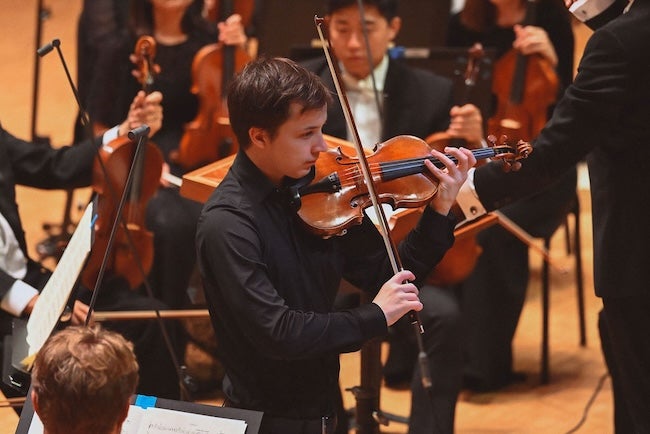
The standout of the evening came during the first half, with support from guest violinist Johan Dalene. He performed the Brahms Violin Concerto with expert musical athleticism and a bit of panache. The piece leans into showmanship: Brahms wrote a violin concerto full of great riffs, intervallic pretzels of notes that twist and turn and fall in on themselves. These passages, including the Joseph Joachim-penned cadenza in the first movement, tumble through the orchestra as in a fast-moving stream, with folk-like double stops – harshly articulated and biting – propelling the music along.
I haven’t heard the Brahms Violin Concerto in Atlanta for a few years, but it was once well-trod territory. In 2018, guest conductor Roberto Abbado performed it here with Veronika Eberle. Two years earlier, David Coucheron, then in his sixth season as concertmaster, dazzled in the work (that concert also celebrated bassist Jane Little’s record-breaking 71st year playing with the same orchestra). Joshua Bell, who performed at Symphony Hall last week, brought the Brahms with him in 2014.
While the Violin Concerto is full of thrills and memorable music, my favorite movement has always been the folksy third. Thursday, the ASO played the main theme with an exaggerated hitch in the melody – Stutzmann moving up to physically pull the music up to a brief stop, underlying the jauntiness of the tune. While it came as a surprise – my favorite recordings present the melody differently – I warmed to it as just another example of how Stutzmann is bringing her version of these classic melodies to life.
Now, on to the unanswered question: Will Atlanta be tired of Brahms after eight concert series exploring the composer’s works? After a successful Beethoven project that similarly put the familiar composer under a microscope, it seems like there’s a real demand for these deep explorations of seminal composers.