ASO Unearths Bruckner, Andsnes Shines with Beethoven
Concert Reflections with Jon Ross
In this series from local music journalist Jon Ross, he reflects on the ASO’s Delta Classics Series with fresh insights into each concert.
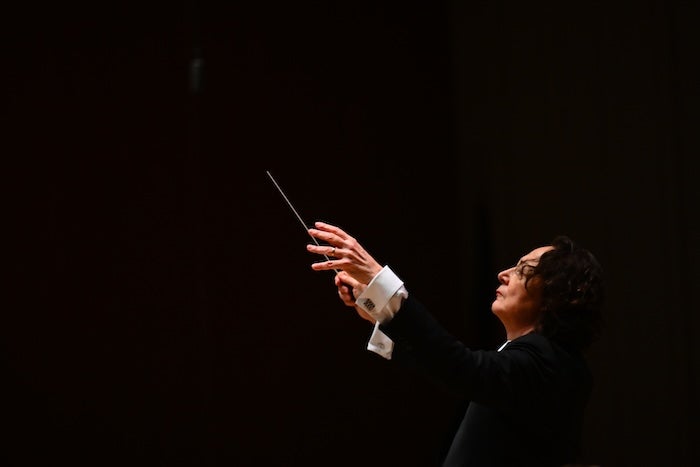
Photos by Adam Hagy
Nearly four decades ago, the Atlanta Symphony Orchestra, led by guest conductor Franz Wesler-Möst, performed Bruckner’s Sixth Symphony for the first time. The orchestra then shelved the score for the next 37 years.
Thursday at Symphony Hall, Stutzmann resurrected the heraldic, expansive world-creating Bruckner work.
Bruckner’s symphony is an overflow of emotion. It’s gripping, heart-on-your-sleeve music, and Stutzmann rearranged the orchestra a bit to best achieve this maximalist outpouring of feeling. Positioning the cellos at the center of the orchestra and adding a row of eight basses on risers at the back of the stage, Stutzmann made sure a powerful low end issued from the center of the ensemble, grounding this expression through radiant fortes and luxurious pianissimos. The music also derives a lot of power from the horns, and the section, led by principal Ryan Little, proved more than up to the task.
Interpretation and programming are perhaps two of the most apparent ways a music director shapes an orchestra’s identity. Interpretations aside, the success of which are much in the ear of the beholder, Stutzmann has well established her programming world view as she nears the end of her fourth season at the helm in Atlanta.
The rapturous Brahms made a great case for her approach: mining the classical cannon for composers with which both orchestra and conductor feel a deep kinship is no less valid than her predecessor’s alignment with living composers. And it can be even more rewarding; dusting off a forgotten composition from a familiar name more often than not leads to instant audience gratification.
And yes, the ASO has performed quite a lot of Bruckner recently. That’s to be expected, as the composer has become part of the go-to group of composers when Stutzmann is in town. During her second season with the ASO, she paired the composer’s Ninth Symphony with his “Te Deum” as part of a mini birthday party for the composer’s 200th anniversary. The ASO followed that performance the next week with Bruckner’s Seventh Symphony. A performance of Bruckner’s Fourth Symphony came next in November 2024.
If Bruckner is a frequent undertaking, so too, of course, is Beethoven. During the first half of Thursday’s program, pianist Leif Ove Andsnes performed the composer’s Third Piano Concerto. The inclusion on the program represented perhaps a continuing echo of the ASO’s successful Beethoven Project. Stutzmann had last conducted Beethoven’s Third Piano Concerto less than three years ago, with pianist Lise de la Salle. But it was well worth hearing the work again so soon from a much-celebrated and awarded pianist making his debut in Atlanta.
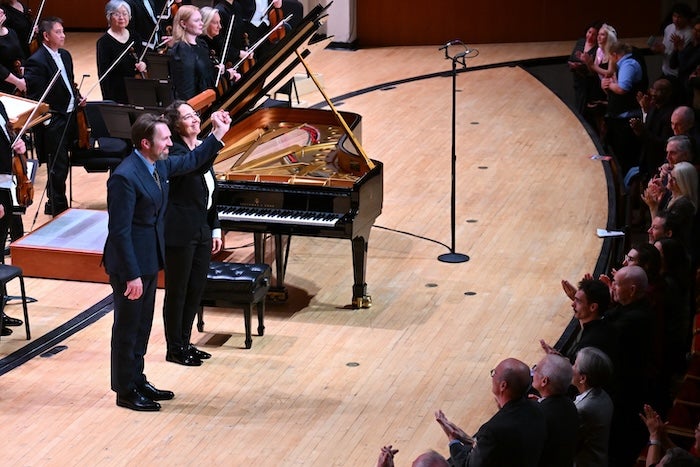
For me, Andsnes’ performance truly came alive during the cadenza in the first movement. With the orchestra silent behind him, loud, voluble barrages of chromaticism, a babbling brook of notes, gave way to tight, controlled trills in the softest, sweetest pianissimo. Next, a delicate cascade of arpeggios, backed by timpani, led the way for a reemergence by the orchestra.
In the opening of the second movement, Andsnes brilliantly created a personal space for reflection, just the pianist and keyboard, with a glorious hymn of celebration before the orchestra entered. The concerto, Beethoven’s only piano concerto in a minor key, is full of dark and stormy bombast, but I will remember more the serene passages, as smooth and peaceful as a lake in the morning mist.
Andsnes is one of the more memorable guests to Atlanta in recent years, and the combination of his extraordinary performance with a Bruckner gem, made for an exquisite night at Symphony Hall.