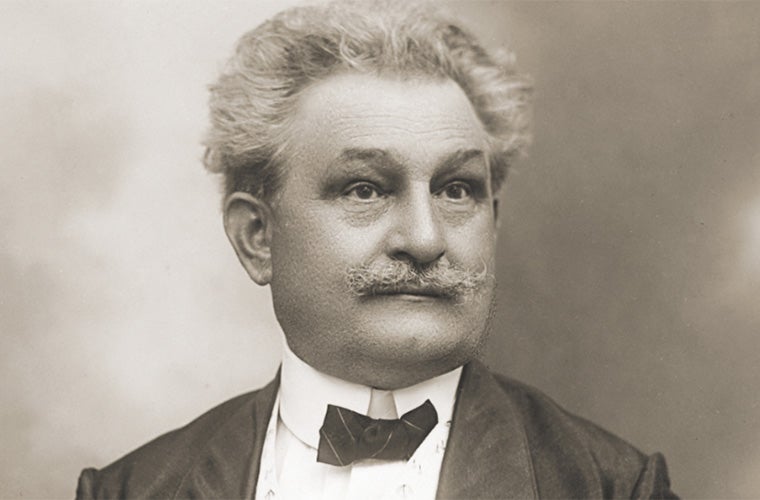
Leoš Janáček
1854 - 1928
Biography
Born in Hukvaldy, Moravia (part of 20th century Czechoslovakia) in 1854, Leoš Janáček is considered the greatest Czech composer of the early 20th century.
He was the son of a schoolmaster and, as a boy, sang in the choir of the monastery in Brno. He later went to Prague to study music and made a living there teaching music. In 1881, he moved back to Brno and founded the Organ School, which would become the Brno Conservatory.
He began composing in a relatively traditional romantic style; but after his opera Sárka (1881), his style began to change. He made a study of Moravian folk music and used elements of it in his own music. His opera Jenůfa (1904) had very distinctive vocal melodies which closely followed the rhythm and pitch of normal Czech speech. This became a distinguishing feature of his vocal writing.
When Jenůfa was performed in Prague in 1916, it was a great success and brought Janáček real acclaim for the first time. He was 62 at the time and began to compose the pieces for which he is now best known. The operas Katya Kabanova (1921), The Cunning Little Vixen (1924), The Makropulos Affair (1926), and From the House of the Dead (premiered posthumously in 1930) are regarded by many as his finest works.
Other well known pieces by Janáček include the Sinfonietta (1926), the Glagolitic Mass (1927) (with words from a text in the Glagolitic alphabet), and his two string quartets. He died in Ostrava, Czechoslovakia, in 1928.