IAMKHEMESTRY
Biography
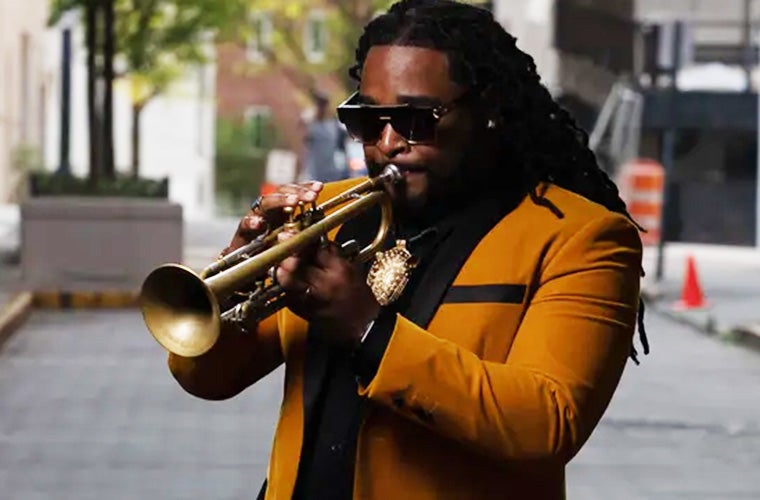
When you think of Melvin “IAMKHEMESTRY” Fowler, the word maverick often comes to mind—not because he resists tradition, but because he honors it so deeply that he feels compelled to extend it. A trumpeter, composer, and multidimensional artist from New York City, Melvin embodies unfiltered musical truth and disciplined imagination. His journey began when his mother placed a trumpet in his hands to keep him focused and grounded, a decision that would shape his life’s work. That early devotion quickly placed him in rare rooms, including a formative lesson in Wynton Marsalis’s living room over Thelonious Monk’s “Blue Monk,” setting the foundation for a path that led to acceptance into The Juilliard School. There, he forged a singular artistic voice—one that seamlessly blends jazz with hip-hop, Afrobeat, gospel, funk, classical, and R&B—while performing alongside an expansive range of artists across genres and generations such as Jon Batiste, Ray Chew, Adam Blackstone and the late great Richard Smallwood.
Rooted in lineage and vision, Melvin founded The IAMKHEMESTRY Orchestra and the IAMKHEMESTRY small group as an homage to Duke Ellington and the Black brilliance of the Harlem Renaissance. His first major large-ensemble work, the four-movement suite Where’s My Basquiat?, drew direct inspiration from Jean-Michel Basquiat’s paintings. Studying brushstrokes, color palettes, and emotional tension, Melvin translated visual language into sound, using staff paper as canvas and composition as paint. The suite became both a personal inquiry and a communal challenge—an invitation for artists to claim their creative responsibility and contribute boldly to the cultural memory of their communities.
Since relocating to the Atlanta area in 2020, Melvin has centered his life around family, faith, and service. A devoted husband and father of three, he has cultivated a home where music is lived daily—his children all play instruments, transforming their household into a living conservatory. This commitment to family extends naturally into community, where teaching, mentorship, and cultural stewardship are core to his mission. Whether on tour, in the classroom, or guiding young musicians, he approaches education as an act of preservation and empowerment, ensuring that knowledge, history, and artistry are passed forward with intention.
Continuing this work of remembrance and restoration, Melvin debuted a new suite honoring the legacy of Seneca Village—a once-thriving Black community displaced in 1857—performed on Juneteenth in the very place the village once stood. The project reflects his belief that music functions as memory technology, capable of restoring erased stories and reconnecting people to ancestral truth. Alongside this work, he is developing a music mentorship program culminating in a summer music camp in Atlanta, designed to nurture young artists technically, creatively, and historically. Across every discipline he touches—performance, composition, education, writing, and painting—Melvin stands as an “old soul” and contemporary conduit, using sound as a compass and art as a living archive for future generations.