Ross Reviews: Negrón’s Optimism Breathes Life into ASO Program
Concert Reflections with Jon Ross
In this series from local music journalist Jon Ross, he reflects on the ASO’s Delta Classics Series with fresh insights into each concert.
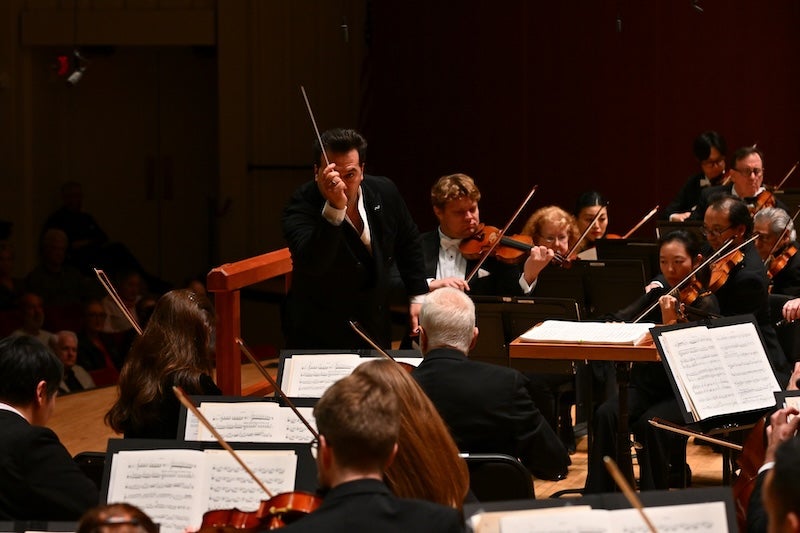
Photos by Adam Hagy
The bells toll from a keyboard, issuing forth as a woozy, electronic sound, grounded by a throbbing, insistent beating from the harp. Flute and woodwinds drift through the soundscape with a slow melodic figure, growing, expanding, exploring. Cellos rise from the depths in a dirty, earthy glissando.
In this initial tableaux, darkness pervades, but it’s the kind of black nothingness before the dawn, not of the endless night.
Guest conductor Robert Treviño opened Thursday’s Atlanta Symphony Orchestra concert with this ballet between despair and hope at the heart of Angélica Negrón’s 2020 work "En otra noche, en otro mundo.”
Pianist Sergei Babayan then joined the orchestra for Rachmaninoff’s fourth piano concerto, and Treviño ended the program with the first ASO performance of Alexander Zemlinsky’s moving and heartbreaking “The Mermaid.” A free meet and greet with Negrón, who was in the audience on Thursday, is set for 1:30 on Saturday at Symphony Hall before an 8 p.m. repeat performance of the program.
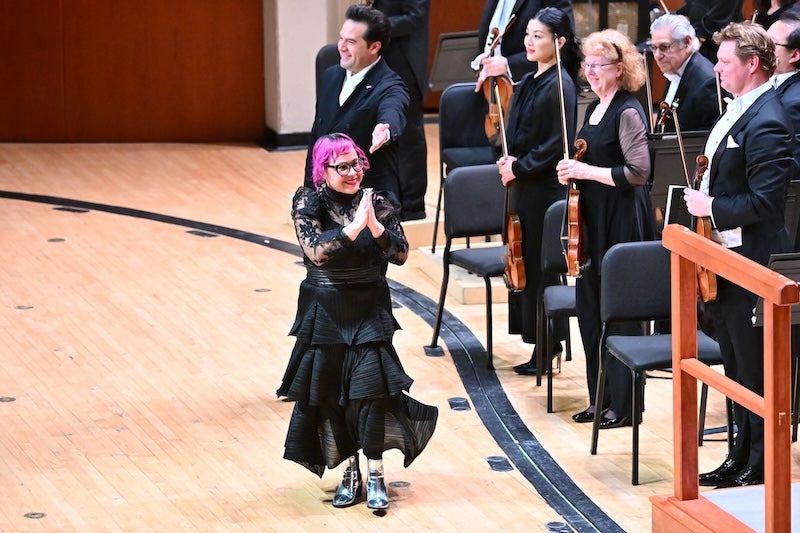
Composer Angélica Negrón
Negrón’s composition draws inspiration from the Alejandra Pizarnik poem of the same name, “On another night, in another world,” which ends with the line “the one I wait for doesn’t come.” (Negrón’s bell work also pays homage to tintinnabuli, Arvo Pärt’s name for his compositional technique.) The composer has indeed created a piece that sounds not of this world, but is still accessible and rewarding. Instead of the prolonged longing hinted at in the end of the poem, there is confidence throughout Negrón’s work. It’s a confidence that whatever darkness exists now, the future can be filled with light.
The piece is about longing, but I didn’t hear much anguish and despair in the orchestra’s stirring performance. Perhaps there’s a bit of knowledge at the heart of the piece that hard times won’t last forever, the overwhelming need for someone/something will fade, or at least become more manageable, with time. There’s hope in the bedrock of the music, which ends as it began, in nothingness.
The ASO closed Thursday’s concert with a much older work based on another literary text. Zemlinsky took inspiration for “The Mermaid” from the Hans Christian Anderson tale of … well … longing and despair. Zemlinsky composed the mimetic work after losing the love of his life to Gustav Mahler. It all began Thursday with a low, primordial opening – an introduction that’s tricky to get right – with every sound issuing from the deep. Even in long passages of jubilation, as in much of the second movement, the stain of loss, of yearning for what you can’t have, was an undercurrent. And when the darkness surfaced Thursday in these somewhat joyful stretches of music, the crushing despair came out of nowhere like a debilitating shot. Treviño handled these destabilizing blows wonderfully, delivering disorienting blows of melancholy.
Treviño took great care to highlight the passion, the extremities of feeling, in all three works. Babayan performed brilliantly in the Rachmaninoff, at times bubbly, at times serious, a complete master of the music. Tonally, the piano concerto worked well with the program’s two bookends, emotional compositions that trafficked in sadness. Optimism won out in Negrón’s piece, but there was no happy, Disney ending for Zemlinsky’s voiceless narrator.
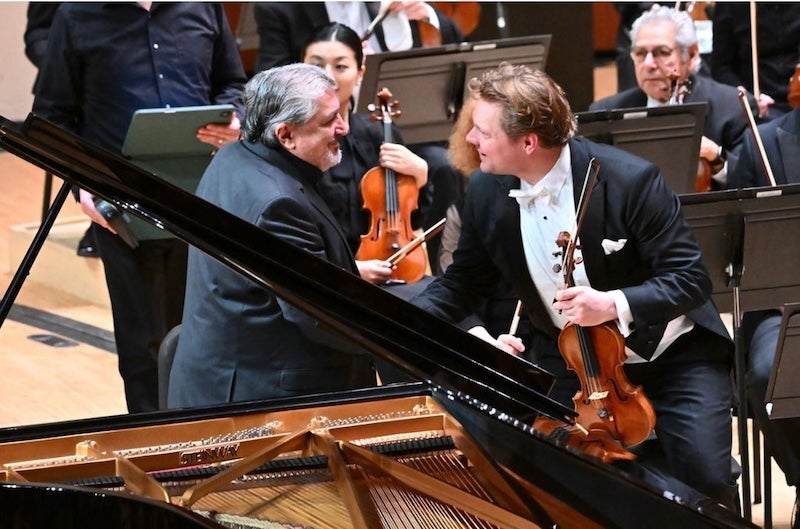
Pianist Sergei Babayan and ASO Concertmaster David Coucheron
In this anniversary year for the United States, it’s rewarding to hear diverse sounds celebrated as part of the new American classical canon. Negrón, born in Puerto Rico, now lives and works in Brooklyn. Rachmaninoff wrote Piano Concerto No. 4 nearly a decade after arriving in the U.S. (though he revised the work twice over the next 15 years), and although Zemlinsky premiered “The Mermaid” while still living abroad in 1905, he moved to the U.S. toward the end of his life.
Thursday’s program reminds us that diversity gives music dimensionality – how performers and composers from backgrounds outside the historical structures of classical music bring different perspectives and ideas to the stage. Juxtaposing Negrón’s composition with the two older works highlighted these differences but also underlined the similarities.